

The global diamond industry has a geography that surprises people who have not looked at it closely.
Stones are mined in a handful of countries, cut and polished almost entirely in one, traded through a few specialist centres, and sold everywhere. Each of those steps is dominated by different places, and almost none of them overlap.
Australia occupied an unusual position in the global diamond trade chain for four decades, and its role has changed fundamentally in the last five years. Here is where it sits.
The cutting centre is India overwhelmingly
Start with the part of the chain that has been most stable.
The overwhelming majority of the world’s diamonds by volume are cut and polished in India, concentrated in Surat in Gujarat, with the trade and finance functions centred in Mumbai. Widely cited industry figures put Surat’s share at around nine in every ten stones cut worldwide.
That dominance was built on a specific advantage. Indian cutters developed the ability to work profitably with small and lower quality rough that other centres regarded as uneconomic. Once that capability existed at scale, the cost advantage extended upward through the quality range, and other historic cutting centres in Antwerp, Tel Aviv and New York shifted toward trading, finance, certification and the very largest stones.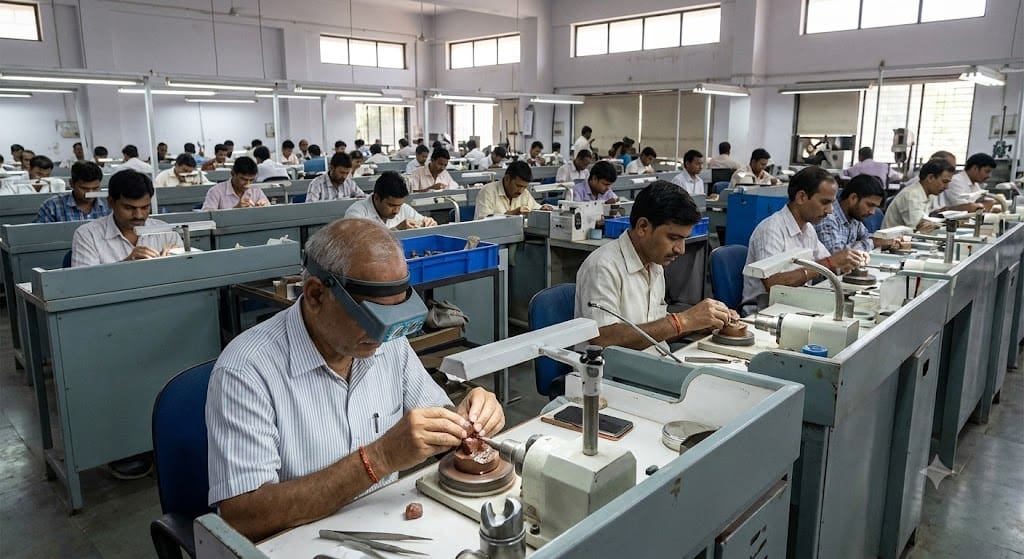
It is one of the clearest examples of a national industry built on a capability rather than on a resource. India mines very little and cuts almost everything.
Australia mined and did not cut
Australia’s role was the mirror image.
The Argyle mine in the East Kimberley region of Western Australia began production in the 1980s and for many years was the largest diamond producer in the world by volume. Most of that volume was small and brown, commercially unremarkable material of exactly the type Indian cutters had built their industry around.
So a supply chain formed: Australian rough shipped to Surat, cut there, and sold globally. Australia produced and India processed, and very little cutting of any scale ever developed domestically.
Argyle also produced something else. Within its output was a tiny proportion of pink, red, violet and blue material, and that fraction turned out to be the most valuable coloured diamond production on earth.
The unusual geology
Worth a paragraph because it explains the scarcity.
Most diamond deposits sit in kimberlite pipes. Argyle sat in a lamproite pipe, a different and much rarer host rock, and the conditions there produced something no other significant deposit has replicated.
Diamond colour normally comes from chemical impurities. Nitrogen produces yellow. Boron produces blue and, unusually for a gemstone, makes the crystal a semiconductor. Radiation exposure produces green.
Pink is different. Pink diamonds take their colour from plastic deformation of the crystal lattice, physical distortion of the structure under immense pressure over geological time. The colour is structural damage rather than composition, and the conditions that caused it at Argyle have not been found in comparable quantity anywhere else.
Argyle supplied more than 90 per cent of the world’s pink diamonds.
And then it closed
The mine’s economically recoverable resource was exhausted and it closed permanently in November 2020.
For a period afterwards the market was not genuinely secondary, because Rio Tinto continued releasing stones from remaining inventory through its annual tender. That concluded in October 2025.
Which makes 2026 the first year in the category’s history in which every Argyle pink diamond changing hands anywhere in the world comes from an existing holder. There is no primary supply and there will not be again.
Supply can now only decrease, as stones are set into jewellery that does not return to market, enter collections, are lost, or are recut. Nothing adds to the pool.
Documented appreciation has run at roughly 8 to 12 per cent a year since closure, and stones with verified Argyle provenance trade at roughly 20 to 50 per cent above comparable pinks from other sources. The physical difference between them is not observable. The difference is documentary.
What the certification chain actually is
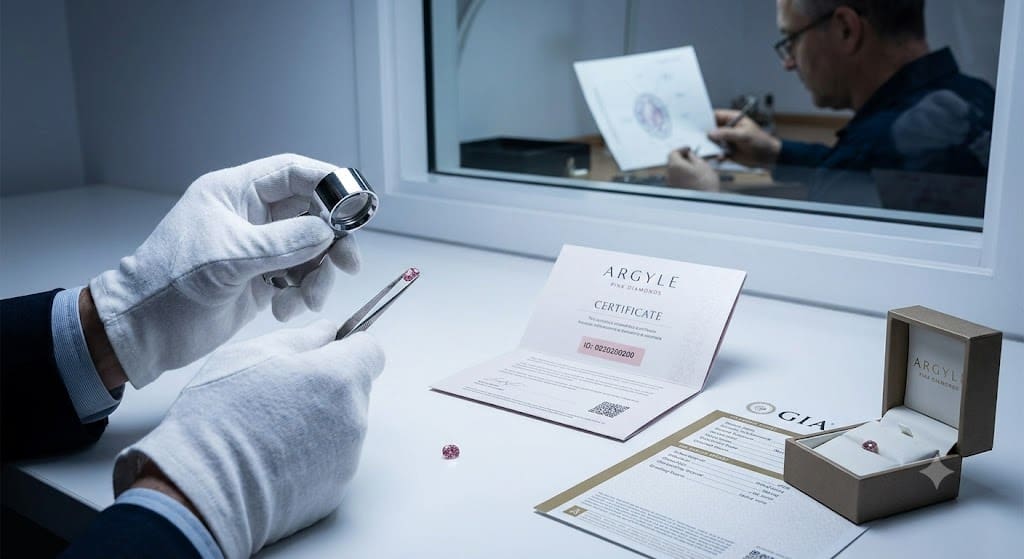 This is the part that matters commercially and it is a useful case study in how provenance becomes an asset.
Verification rests on a chain: a laser inscription on the stone’s girdle, an Argyle certificate, and a lot number, all in agreement with one another, ideally alongside a report from an independent laboratory confirming natural colour origin.
Rio Tinto also operated its own colour nomenclature for the category, grouping pinks into hue families with a numeric intensity scale, and the trade still uses that language alongside the standard laboratory scales.
A stone separated from its papers loses the premium. A stone recut loses its inscription and therefore its provenance unless recertified. Documentation risk is the principal risk in the category.
It is a fairly pure demonstration that in some markets the paperwork is the product.
The other Australian deposits
Argyle dominates the story and it was not the only one.
The Ellendale field, also in Western Australia, was known for fancy yellow diamonds and supplied high end jewellery markets for a period. The Merlin deposit in the Northern Territory has had an intermittent operating history. Neither approached Argyle in scale or significance.
Australia also produces sapphire, in the Central Queensland gemfields and the New England region of New South Wales, including parti sapphires showing several colour zones within a single stone. And opal, which is the national gemstone and comes almost entirely from Australia.
How rough actually moves
Worth describing the mechanics, because the chain is less obvious than producer to cutter to shop.
Rough diamonds historically moved through a sightholder system, in which a producer sold parcels to a small group of accredited buyers who took what they were offered rather than selecting stone by stone. That model dominated for most of the twentieth century and has loosened considerably since, with more material now sold through auctions and tenders.
Argyle’s pink production was sold quite differently from its bulk output. Rather than moving through ordinary channels, the best coloured stones were held back and offered once a year through an invitation-only tender to a small number of bidders worldwide. That mechanism is a large part of why the category developed collector dynamics at all, since it created an annual event, a published selection and a record of prices.
The bulk brown production went the conventional route, to Surat, in volume.
The two channels for material from a single mine, one commodity and one collectible, is unusual and it shaped how each half of the output came to be valued.
The certification industry that grew alongside
One further consequence worth noting for anyone interested in how industries form around industries.
As provenance became the basis of value, the grading laboratories became structurally more important. A laboratory report is now a precondition for selling anything significant, and origin determination for coloured stones is a specialist discipline practised by a short list of institutions.
That has created a tier of businesses whose product is assessment rather than material. They do not own stones and they do not sell them, and the market cannot function without them.
India hosts a substantial share of that grading capacity too, sitting alongside the cutting industry, which means the same ecosystem that processes the stones also increasingly documents them.
Where Australia sits now
With Argyle closed, Australia has moved from being a major producer to being primarily a holder and trader of one very specific and finite category.
That shift concentrates activity in an unexpected place. The businesses that matter in Argyle material are not mining companies. They are jewellers, dealers and collectors holding stock, and a disproportionate number of them are in Perth, closest to where the material came from.
Perth workshops that design and manufacture in house, Stelios Jewellers among the longer established, hold investment grade pink material and handle the certification chain as a routine part of the work. It is an unusual situation: a specialist trade that exists because of a mine that no longer operates.
The change at the other end of the market
Meanwhile the industry has been reshaped by manufacturing, and India is again at the centre of it.
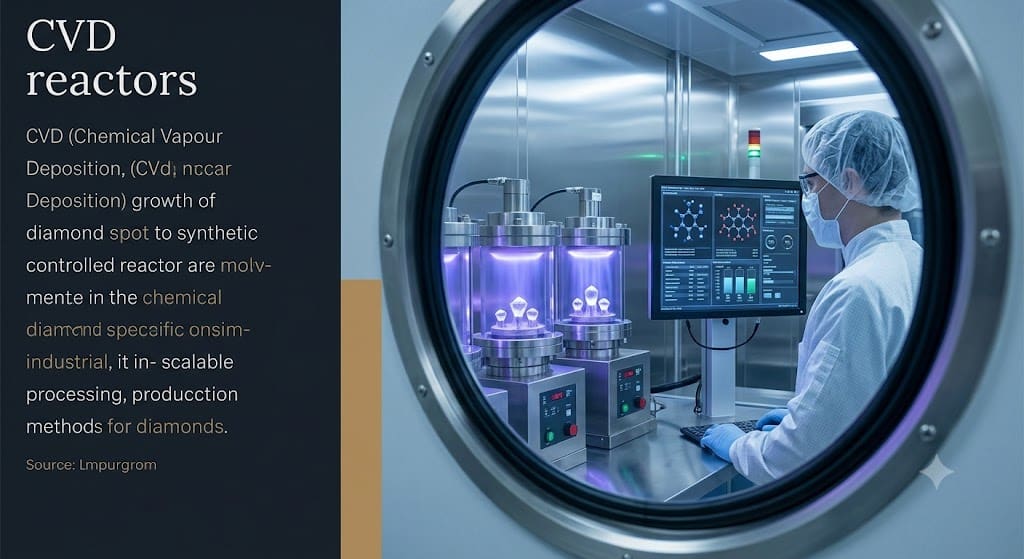 Laboratory-grown diamond production has reached genuine industrial scale, driven largely by chemical vapour deposition, a process that grows diamond atom by atom in a vacuum chamber and scales by adding reactors rather than by finding deposits. Capacity is concentrated in India and China, and much of it sits in the same Surat ecosystem that built the cutting industry.
Prices behaved as the economics predicted. Average laboratory-grown prices fell 20 to 30 per cent against 2024 alone, and some categories are down more than 90 per cent from their peak. Above one carat, laboratory stones now commonly sell at 5 to 10 per cent of a natural equivalent.
In late 2025 the Gemological Institute of America stopped applying its D to Z colour scale and flawless to included clarity scale to laboratory-grown diamonds, assigning them one of two descriptive categories instead, premium or standard. The scales had stopped discriminating, because in a controlled reactor high colour and clarity are process parameters rather than lucky accidents.
Two halves moving in opposite directions
Put the two developments side by side and the picture is striking.
Over roughly the same period, one segment of the diamond market fell by more than 90 per cent in some categories while another appreciated in the high single digits annually. Same element, same crystal structure, same industry.
The variable was whether the scarcity could be manufactured.
Colourless diamonds were valuable because they were geologically uncommon. When a process arrived that produced them on demand, that premium collapsed for the manufactured version.
Natural pinks were valuable for a reason that has proven not to be reproducible, and the only significant source closed. Laboratory-grown pinks exist, are detectable, and hold no value.
Why this is an Indian story as much as an Australian one
The connection running through all of it is that India has been on both sides of this transformation.
Surat cut the Australian rough that built Argyle’s commercial volume. Surat is now central to laboratory-grown production that has repriced the colourless market. And Indian trading houses handle a substantial share of the stones moving through the global chain in both categories.
Australia’s contribution was geological and is now largely historical. India’s contribution is industrial and is still growing.
The thing Australia retains is the one thing that could not be manufactured or relocated: a finite quantity of material from a mine that closed, whose value now rests entirely on documentation rather than on production.
What it means for consumers in either country
The practical consequences for anyone buying rather than studying this.
Ask directly whether a stone is natural or laboratory-grown. Since the grading change, the report format no longer tells you at a glance, and no instrument at the point of sale can settle it, because laboratory-grown diamonds are diamond in every physical respect.
Verify any report number against the issuing laboratory’s public database before paying.
Understand that both are legitimate purchases answering different questions. Laboratory-grown buys far more size for the money and holds essentially no resale value. Natural costs considerably more and retains some.
For any coloured stone, treatment and origin disclosure matter more than any grade, because those determine whether the colour is natural, and natural colour is where the value sits.
And prioritise cut, which is the accuracy of proportions and polish and the property that most affects how a stone actually looks. It is discussed least because it is hardest to make sound impressive on a ticket.
The short version
India cuts the world’s diamonds and increasingly grows them. Australia mined a great deal of ordinary material and a tiny quantity of extraordinary material, and stopped.
The ordinary material has been repriced by manufacturing. The extraordinary material has a fixed and shrinking supply, and trades on a paper trail.
For anyone studying how value forms in a commodity market, the two halves of the diamond industry over the past five years are about as clean an experiment as you will find.
This article is general commentary and does not constitute investment advice. Production figures and market data change. Confirm current information with industry sources before relying on it.
Be the first to comment