

You can hear the track in your head. The problem starts when you open a DAW and have no idea what to do next. There are instruments to choose, drums to program, chords to build, effects to understand, and dozens of decisions that seem to require skills you have not learned yet.
That is why text to music has become an interesting starting point for beginners. Instead of building a track instrument by instrument, you can begin by describing what you want to hear. The first result gives you something much easier to work with than an empty project: something you can react to.
You still will not become a producer overnight, and that does not need to be the goal. If you know that a track feels too dark, too busy, too slow, or surprisingly close to what you imagined, you already have useful information. You can start there.
You Probably Know More About the Music Than You Think
People who have never produced music often assume they have nothing useful to contribute until they learn the technical side.

But think about how you already listen to music.
You can probably tell when a song feels too dramatic for a quiet scene. You notice when an intro seems to drag. You know that one track makes you want to move while another feels better late at night. You may not know what is happening with the compression, harmony, or sound design, but you still have a reaction.
That reaction matters.
A producer might translate “I want this to feel like driving through a city at 2 a.m.” into choices about tempo, drums, synths, bass, effects, and arrangement. You do not necessarily need to understand those decisions before you can communicate the original feeling.
The same applies to purpose.
Maybe you need something upbeat behind a travel video without overwhelming the footage. Perhaps you want quiet piano music that gradually becomes hopeful. You could be imagining a dark electronic track for a game scene or something playful for a short social video.
Those are not technical instructions, but they are creative instructions.
Production knowledge gives you more ways to change a track. Taste tells you why it needs changing in the first place.
A Simple Three-Step Way to Start
Your first attempt does not need a complicated workflow. Describe what you want, listen to what comes back, and use your reaction to make the next version more specific.
For someone without production experience, it is much easier to start with a simple description and judge the result by listening than to build every musical element manually. The first question does not have to be “How was this produced?” It can simply be “Does this sound like what I had in mind?”
Step 1 – Describe the Situation, Not Just the Genre
A common first prompt is something like:
Make an upbeat pop track.
It is not wrong. It just leaves almost every interesting decision open.
Try describing where the music belongs.
For example:
Warm, upbeat indie pop for a summer travel video. Light guitar, relaxed drums, and a gradual lift in energy without becoming too dramatic.
You do not need to know the exact BPM, chord progression, guitar tone, or mixing chain. The description already communicates several useful things: warm rather than dark, energetic without becoming aggressive, and suitable for supporting a visual rather than dominating it.
Think about mood, movement, time, place, and purpose.
“Soft instrumental music for an early morning train ride through the countryside” creates a clearer picture than “peaceful music.”
“Bright electronic music for the moment a new product is revealed in a fast social video” gives the track a job rather than simply assigning it a genre.
If you know technical details, use them. If you do not, describe the experience.
Step 2 – Listen for What Feels Wrong
When the first track appears, resist asking whether it is simply “good” or “bad.”
Those questions are too broad to help much.
Instead, listen for the first thing that feels wrong.
Maybe the drums are heavier than you imagined. Perhaps the piano makes the track sentimental when you wanted it to feel peaceful. The introduction may take too long, or the music might reach its highest energy before the moment in your video that actually needs it.
You do not need production vocabulary to notice any of this.
Instead of thinking, “I don’t know how to fix the arrangement,” describe the difference you want:
Keep the relaxed mood, but make the drums softer and bring the guitar in earlier.
That is already a meaningful production decision, even if you could not explain how to make the change manually inside a DAW.
Step 3 – Keep the Direction That Works
Easy generation creates a new problem: it is tempting to start over constantly.
Try not to.
If a result gets close to what you imagined, identify what is already working before changing anything.
Maybe the mood is right but one instrument bothers you. Perhaps the opening is exactly what you wanted, but the second half loses energy. You may like the rhythm and dislike the overall sound.
Keep the useful part and make a smaller change.
Otherwise, you can spend an hour generating completely different tracks and end up further from the original idea than when you started.
Learning what not to change is part of making music too.
Do Not Pretend to Be a Producer in Your Prompt
Beginners sometimes assume that better music requires more professional-sounding prompts.
That can backfire.
You do not need to fill a description with terms such as sidechain compression, transient shaping, stereo imaging, suspended chords, syncopation, or specific synthesizers unless you understand what those choices are supposed to accomplish.
A technical term is useful when it makes your intention clearer. It is not useful simply because it sounds like something a producer would say.
Plain language can be surprisingly precise.
Imagine you want music for a scene where someone leaves a crowded party and walks home alone. You could describe the transition from noisy and energetic to spacious and reflective. You could ask for the rhythm to remain present while the arrangement gradually becomes quieter.
That tells the music something important about the scene.
The same approach works for YouTube videos, podcasts, games, presentations, social content, and personal projects. Describe what is happening around the music and what job the music needs to perform.
You can learn the vocabulary later when you actually need it.
Your First Track Does Not Need to Sound Professional
There is a strange side effect to generating polished audio quickly: beginners can start judging their ideas as though every attempt should already sound like a finished release.
That makes experimentation harder than it needs to be.
Your first track has a simpler purpose.
It should help you hear something that previously existed only in your head.
Maybe the melody is not memorable enough. Perhaps the atmosphere is perfect but the instrumentation is wrong. You might discover that the cinematic idea you imagined actually works better when it is smaller and more acoustic.
None of those outcomes means the attempt failed.
Before hearing the track, you had a vague idea. Now you have an opinion about its tempo, mood, energy, structure, or instrumentation.
Even saying, “I hate those drums,” is progress.
You have identified a decision that needs to be made.
That is much more useful than staring at an empty project.
You Can Make Music Without Becoming a Producer
Not everyone who wants to create music wants to spend the next several years becoming a music producer.
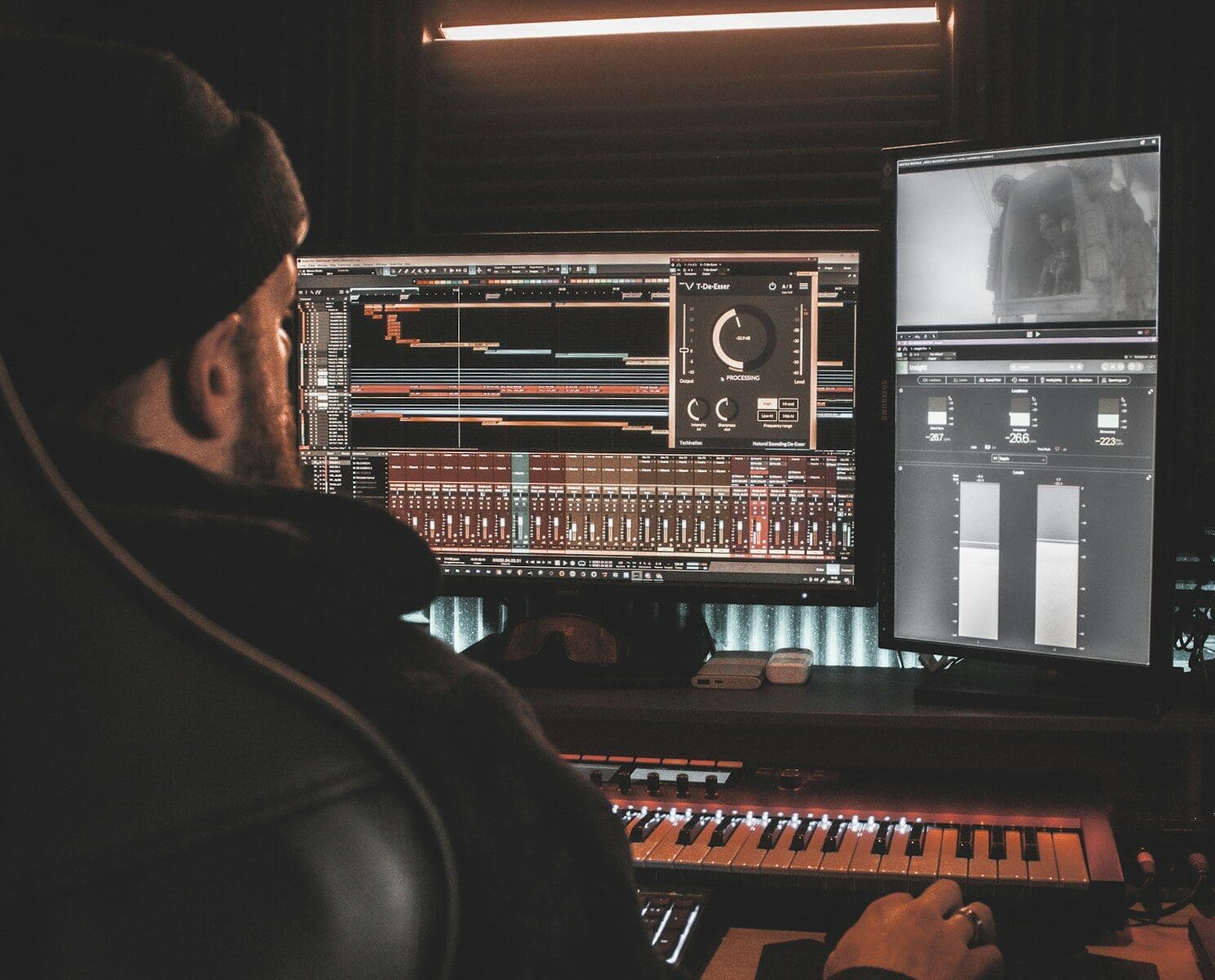
A video creator may need an original background track. Someone making a birthday video might want music that fits a particular memory. A game developer may want to test the atmosphere of a scene before commissioning a finished soundtrack.
For those people, making music may be part of another creative project rather than the project itself.
There is nothing wrong with stopping there.
But sometimes creating a few tracks makes the technical side more interesting.
You might start wondering why one drum pattern feels better than another. Maybe you want to know why changing the tempo affected the mood so much. Eventually, you might open a DAW because you want to change one instrument without affecting everything else.
That is a good reason to learn.
You do not need to begin with a course covering every production concept. Learn things when they solve problems you have actually encountered.
Understanding tempo becomes useful when “faster” is no longer specific enough. Learning basic song structure helps when you want more control over where energy rises. Understanding stems becomes useful when you want to edit individual musical parts.
In that case, AI has not replaced learning production.
It has given the technical knowledge a purpose.
The Real Skill Is Learning to Choose
Removing technical barriers does not remove creative decisions.
In some ways, it creates more of them.
If you can generate another genre, another arrangement, another mood, and another variation whenever you want, you can quickly end up with too many options.
At some point, you have to choose.
Which version actually matches the original idea? Which unexpected choice made the track better? What needs another change? What are you changing simply because another option is available?
A producer with years of experience has more ways to execute those decisions manually. That experience matters, especially when precise control is required.
But the decision about what belongs in the track comes from somewhere else.
It comes from listening.
This is why beginners should not dismiss their own reactions just because they cannot explain them technically. If the chorus suddenly feels right, pay attention. If an instrument keeps distracting you, pay attention to that too.
Over time, you can learn the language for why those things happen.
You do not need that language before you are allowed to notice them.
Conclusion
You do not need to understand a DAW, mixing, music theory, or sound design before experimenting with your first track.
Start with something you already understand: the feeling, scene, energy, or purpose of the music. Describe it in ordinary language. Listen to what comes back and notice what you want to keep, remove, or change.
You may eventually learn production because you want more control. You may simply use music as one part of another creative project.
Either path is valid.
You may not know how to produce the music yet. But if you can hear when something feels wrong or when it suddenly feels right – you already have somewhere to start.
Be the first to comment