



“Walking just for the pleasure of walking, freely and firmly, without hurrying. We are present in every step. When we wish to speak, we stop walking and lend all our attention to the person before us, to speaking and to listening… Stop, look around, and see how wonderful life is: the trees, the white clouds, the infinite sky. Listen to the birds, delight in the light breeze. Let us walk as free people and feel our steps growing lighter as we walk. Let us appreciate every step we take.” — Thich Nhat Hanh.
Humans are innately aware of the therapeutic value of a brisk walk, but now science is showing that both the mental and physical benefits can be significantly augmented if such exercise is performed within a forest setting.
Forest bathing combines traditional techniques of mindfulness with a unique approach to nature connection through habits of awareness, presence, and deep observation. It is a research-based framework for supporting healing and wellness through immersion in forests and other natural environments. The Japanese government coined the term in 1982, a translation of “shinrin-yoku,” which literally means “taking in the forest atmosphere.”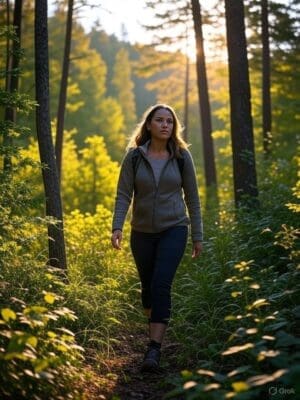

The idea is simple: if a person simply visits a natural area and walks in a relaxed way, there are calming, rejuvenating, and restorative benefits to be achieved.
Human beings have always known this intuitively. But in the past several decades, there have been many scientific studies that demonstrate the mechanisms behind the healing effects of simply being in wild and natural areas. For example, many trees give off organic compounds that support our “NK” (natural killer) cells that are part of our immune system’s way of fighting cancer.
|
The scientifically-proven benefits of Shinrin-yoku include:
Just as impressive are the results that we are experiencing as we make this part of our regular practice:
|
As far as preventive medicine goes, forest bathing seems to significantly mitigate the root cause of a multitude of ailments: stress. Excess stress can play a role in headaches, high blood pressure, heart problems, diabetes, skin conditions, asthma, and arthritis, among many other ailments. As the results indicate, forest bathing catalyzes increased parasympathetic nervous system activity which prompts rest, conserves energy, and slows down the heart rate whilst increasing intestinal and gland activity.
It seems certain that forest bathing acts as a simple yet profound preventive measure for stress-induced disease, as well as simply serving to take the edge off of the minor stressors that plague the day-to-day life of the average Westerner. Forest therapy approaches such as Shinrin-yoku have roots in many cultures throughout history.
Forest bathing has been evolving toward a formal, guided practice that in Japan, Korea, the U.S. and Europe. People are taking this up as a career, and you can become a certified Forest Bathing Guide if so inclined. Among the core services that guides provide are to simply slow people down, and to call attention to sensory experience. It sounds simple, but for most people it’s challenging without some facilitation.
John Muir wrote, “Thousands of tired, nerve-shaken, over-civilized people are beginning to find out that going to the mountains is going home. Wilderness is a necessity.” 
Create your own experience with forest bathing! What can you do if you are not near a forest preserve? Simply remove your shoes and walk barefoot in your own backyard.
- Experience the earth and the ground and take time to meditate on your blessings
- Be mindful of your life, your health, your body and your being
- Make forest bathing a ritual within your family and within your home
- Get back to nature…it is easy…it is cost-effective…and the benefits are real