


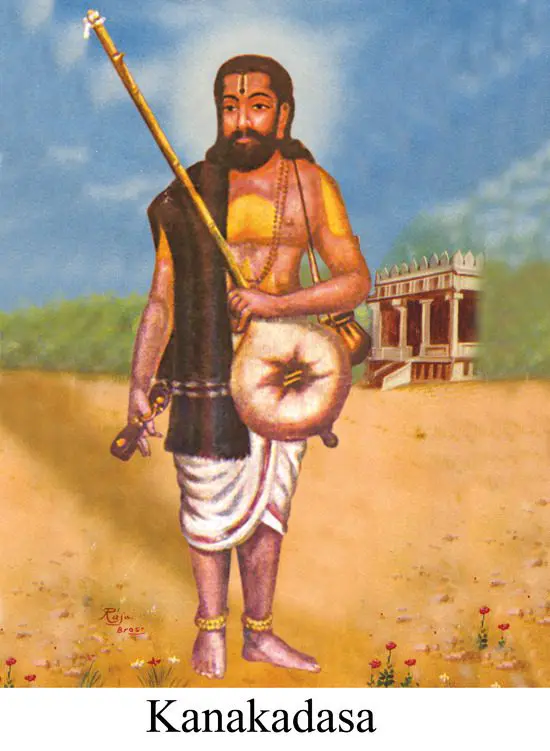
Important amongst the Bhakthi (Love of god) movement is the Haridasa movement. Haridasas or the servants of Lord Vishnu were followers of Madhvacharya. Their poems were alluded to as kirtanas. The first kirtanakara was Narahari Tirtha. The poems endeavored to bring about a social and moral reformation. Another poet Sripadaraya composed songs to describe the romantic boyhood of Krishna and his childish pranks through the eyes of Yashoda.
Then followed the movement by Purandaradasa and Kanakadasa.
Purandara Dasa was a staunch devotee of Purandhara Vittala of Pandarpura, and his verses always concluded with the Lord’s name. He is considered as ‘ Father of Carnatic form of music’
A few of his memorable images:
Kendake orale muttuvudunte?………... Do ants cluster around a hot coal?
Hasida bekku hatthiya tindanthe…………….. A hungry cat eating cotton

Kumaravyasa summed up the spirit if the “Age Of Devotion” and was followed by Kumara Valmiki with his Torave Ramayana and Lakshmisha with his Jaimini Bharatha.
Before concluding the Bhakti era, Sarvajnya, an unconventional poet should be remembered, who became the people’s poet. He was supposed to be an ascetic and hence taken to nomadic wanderings. Illiterate villagers quote hundreds of his vachanas even today.
There was a lull for a period of nearly two centuries, since no significant work was produced. It might be due to the unrest among people, or because of the confrontation of two cultures, Indian and Western.
Honnamma, Chikkadevaraja- the King of Mysore and Singararya, continued some literary activities.
Thus, the Champuyuga made room for the vachana, which included the Bhakthi movement. Pre-modern kannada literature thus was inspired mostly by religious devotion. There were many changes in the thinking of people when Honnamma, the poetess asserted that men and women were equal.
The Christian missionaries may have been the first to use prose in their preaching. Also it was the time of the introduction printing and improved means of communication. The values, thoughts and action of the people combined to give birth to new from of literature.