



If you’ve been finding that your smile lacks the kind of brightness and quality that you really want, you’ve probably come across the field of cosmetic dentistry in your search for perfection. Why has it always been the central issue in life? Because we all know that people notice a beautiful smile. There’s no doubt that a smile is your most important social bonding gesture. Your smile is the total centre of expression, and when it dazzles, you exude confidence, happiness and joy.
What is cosmetic dentistry?
The answer is pretty simple. It’s a discreet blend of cosmetic surgery and dentistry, specifically designed to address the concerns of individuals with stained or damaged teeth. Today’s advanced cosmetic dentistry procedures can enhance your smile to its whitest, straightest, and most beautiful.

Cosmetic dentistry is increasingly popular due to heightened public awareness. Increasingly, celebrities and TV personalities are showcasing their perfect, pearly whites. As people just like you begin having their teeth done, the idea of perfect teeth is quickly becoming the norm.
There’s a whole slew of whitening kits available for private use at home, but they’re not as effective as professional cosmetic dentistry. Furthermore, there’s nothing you can buy over the counter that can fix a chipped or widely spaced tooth.
Cosmetic dentistry is a safe, effective, and painless procedure.
Veneers
Veneers are wafer-thin shells of tooth coloured material (porcelain, ceramic or composite) that are “cemented” to the front surface of teeth to improve their cosmetic appearance. Veneers are typically used to cover stained, misaligned, chipped and broken teeth. They are the treatment of choice used to create the “celebrity smile”.
The most popular type of veneers is porcelain, which offers a stronger and more durable alternative to its composite counterpart. Porcelain veneers also offer a natural, translucent, tooth-like appearance and are more resistant to staining than dental composite veneers.

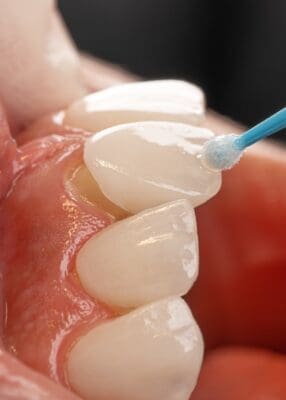
Traditionally, veneers are placed over two visits to the cosmetic dentist. The first visit is for preparation of the tooth and to take an impression, and the second is to fit the veneer after it has been fabricated by a dental technician. Some cosmetic dentists have invested in in-house ceramic studios (CEREC) that utilise CAM/CAD technology, allowing them to produce veneers on site within an hour. This CEREC technology enables the dental practice to offer single-visit, same-day ceramic veneers.
The procedure
The teeth are numbed with local anaesthetic, and the enamel on the front surface of the tooth is then trimmed back so that it can accommodate the veneer. An impression (copy) of the tooth is then taken using “dental putty” and sent to a dental laboratory that will fabricate the veneer. This process takes about 1-2 weeks. During this wait, the dentist usually fits a temporary restoration to your tooth.
On the second visit, the new porcelain veneer is fitted to the front surface of the tooth. Before fitting the veneer, the dentist may need to trim it to achieve the perfect shape. Before the veneer is fitted, the tooth is cleaned and the front surface roughened with an acid etching gel. A cement is then placed on the veneer, which is then positioned.
Once the dentist is satisfied with the veneer’s appearance, a special light is used to activate the cement and bond the veneer to the etched tooth surface. Any excess cement will be trimmed away and polished to leave a natural-looking restoration.
Lumineers are veneers made from a patented cerinate porcelain that is extremely thin (the thickness of a contact lens). With Lumeneers, the tooth surface does not need to be trimmed, making the procedure quicker and less painful.
Porcelain veneers typically last 5-10 years and so will eventually need replacing. They have been known to fall off and break, and can be damaged by grinding your teeth. Veneers provide a quick solution to creating a smile makeover with minimal damage to the original tooth surface.
Crowns
Dental crowns, also known as caps, are restorations that cover the entire outer surface of a tooth, much like a glove. Crowns are used to rebuild broken or severely damaged teeth, strengthen them, and improve their cosmetic appearance. Crowns can be made from a metal (such as gold), porcelain or ceramic.

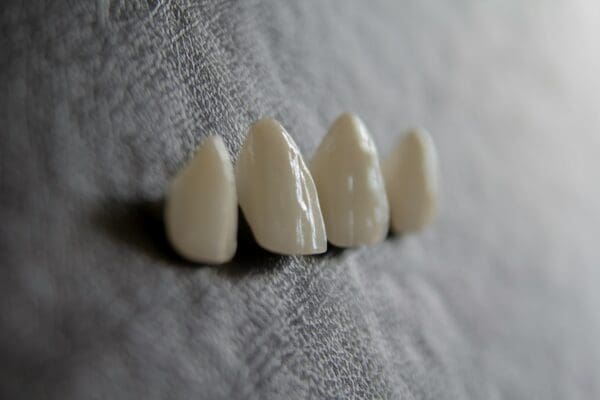
Crowns should not be the first treatment of choice just to improve the aesthetics of your teeth, because a dentist needs to grind a significant portion of the original tooth away. Less invasive alternatives include veneers or dental bonding.
Crowns are required when the strength of the tooth supporting the restoration is compromised, since veneers and dental bonding restorations are only as strong as the supporting tooth.
The procedure
The dentist will remove any decay and grind the tooth to an appropriate shape under local anaesthesia. The shape of the tooth is usually tapered to allow the crown to slip over and onto it. The dentist takes an impression (mould) of the tooth using “dental putty” which is then sent to the dental laboratory who fabricates the crown to exactly fit the tooth. This process can take up to 5 days. During this time, you may be given a temporary crown to wear that is made by your dentist. If your dental practice has CEREC, a porcelain crown can be fabricated on-site within one hour and fitted during the same visit.
When the crown has been fabricated, the dentist removes the temporary crown and evaluates if the new crown provides a perfect fit, colour match and aesthetic result before cementing it into place. A good dental crown will last 10-15 years.
Lumineers
LUMINEERS® BY CERINATE® are porcelain veneers that offer the painless way to a permanently whiter and perfectly aligned smile. Your LUMINEERS cosmetic dentist can apply these contact lens-thin “smile shapers” to teeth without any grinding or shaving, transforming teeth into a naturally beautiful smile that looks perfect for every individual. LUMINEERS can even be placed over existing crowns or bridgework without having to replace them.
LUMINEERS are contact lens-thin and are placed over existing teeth without having to remove painful tooth structure (unlike traditional veneers). LUMINEERS is the painless, permanent cosmetic solution for stained, chipped, discoloured or misaligned teeth.
LUMINEERS can only be made from patented Cerinate porcelain, unavailable anywhere other than the Cerinate Smile Design Studio. In just 2-3 visits to your LUMINEERS dentist, you can have a custom-made smile that is clinically proven to last over 20 years – and it is completely reversible since your natural tooth structure is still intact!
Cerec restorations
Most dental restorative methods require more than one visit to the dentist. This means that on the first visit, you get an injection of anaesthesia, your tooth is prepared, an impression is taken, and a temporary restoration is put on your tooth. You make a second appointment for a couple of weeks later, get another injection, have the temporary pried off, and have a permanent restoration put on.
CEREC by Sirona Dental Systems is the world’s only system for fabricating all-ceramic dental restorations in a single visit to your dentist. With CEREC at your dentist’s side, you can be in and out in a single visit with a permanent, all-ceramic crown, onlay, or veneer! For you, the patient, this means fewer injections, less drilling, and less time out of your hectic schedule for dental care.
For CEREC treatments, your dentist will prepare the tooth in the same way they would for a crown or veneer. But instead of taking an impression of the tooth with “putty”, an optical impression of the tooth is taken with a camera. This digital impression is then converted to a computerised model of your tooth, which the dentist modifies using CEREC 3D software. Once the dentist is satisfied with the digital image, the data is sent to a milling machine on site, which produces your restoration within 30 minutes from a ceramic block. The restoration is then ready to fit.
Implants
A dental implant is a titanium post that is surgically placed into the jawbone and integrates with the bone structure to provide support for bridges, crowns or dentures. A whole row of implants can be used to create a complete dental reconstruction. It is the only procedure that maintains the strength and integrity of the jawbone and provides an independent restoration without damaging neighbouring healthy tooth tissue.
The procedure
Placing dental implants requires the skill of an experienced dental surgeon. It is advisable to check the credentials of the dentist offering implants and their experience in this field. Implants can often be placed under local anaesthesia and IV sedation, but in some cases, a general anaesthetic may be required.
The gum where the implant is to be placed is cut and lifted, and a small hole is drilled into the jawbone using a special drill. The titanium implant is tightly fitted into this hole, and then the gum is stitched back over the implant. If there is insufficient bone material to accommodate the implant, a bone graft may be required, or alternatively, the dentist may use smaller-sized mini-implants.
Over the next 6 months, the implant heals and integrates with the surrounding jawbone. During this time, patients can continue to wear dentures. After 6 months, the gum is lifted again, and a post is attached to the implant with a temporary crown. 4-6 weeks later, when the surrounding gum tissue has matured, the final permanent restoration can be fitted to the implant. Dental implants offer a strong, long-term solution for missing teeth, with a lifespan of up to 20 years.
Orthodontics – Invisalign
Orthodontics is a specialist branch of dentistry which involves the straightening and alignment of teeth. It typically involves wearing a brace or retainer for an extended period. The braces are made from wires and springs attached to tiny metal plates or a plastic mould. The brace applies gentle forces to the teeth, encouraging them to adopt a different alignment. The best orthodontic results are achieved with children when their teeth are still growing. Many adults have orthodontic treatment, but the process takes much longer.
The orthodontist will assess the teeth that need to be aligned and create either a fixed or removable brace, which can be adjusted during the treatment to achieve the desired effect. The fixed braces, as their name implies, are permanent fixtures and are removed at the end of the treatment period. In contrast, removable braces can be taken off for eating and cleaning, but are generally worn at all other times.
Some cosmetic dentists offer Invisalign, which uses a series of clear, virtually invisible aligners that are custom-made to fit your teeth and help reposition them gradually over time. The advantages of Invisalign are that the aligners can be removed to eat and clean, and it is not apparent to others that you are having treatment or wearing braces. The aligners are also changed every two weeks.
Invisalign Invisible Braces
Invisalign uses a series of clear aligners that are custom-made to fit you. The virtually invisible aligners gradually reposition your teeth into a smile you’ll be proud of.
- Remove your aligners to eat, brush and floss
- Change aligners every two weeks
- Your teeth move little by little
- Regular progress checks with your dentist or orthodontist
- Results are often in 6 months to 1 year
Why people prefer Invisalign
- Most people won’t notice you’re in treatment
- Won’t disrupt your lifestyle
- Free initial consultation with participating doctors
- No metal wires or bands to irritate your mouth, and best of all, most people won’t notice you’re in treatment.
- Invisalign®, the clear alternative to traditional braces, has been chosen by over 490,000 people who want a fantastic smile.
Bridges
A dental bridge is essentially a false tooth (hollow crown) and is used to replace missing teeth. A bridge is attached to the two other teeth around the space – “bridging” them together.
The teeth on either side of the space are first prepared by your dentist under local anaesthesia. A small part of each of the surrounding teeth is trimmed away to make room for the new crown. The dentist will then take an impression of the teeth using “dental putty” and send this to the dental laboratory to make the bridge and crown from. The dentist will fit a temporary bridge whilst the new one is being fabricated.
At your next appointment, the temporary bridge will be removed. The new permanent bridge will be evaluated for fit, colour match and how it affects your bite. Once the dentist is satisfied with the restoration, the new bridge will be cemented into place over the surrounding teeth. Alternatives to bridges include less stable dentures or a more permanent and invasive dental implant. Bridges can last up to 10 years if properly looked after.
Gum reshaping – “gummy smile”
Patients are often concerned that too much gum is showing when they smile or that their teeth look too short. This problem commonly referred to as a “gummy smile” can be easily remedied by gum reshaping or contouring.
Excess gum tissue is marked out by the dentist and then trimmed away using a special laser, which also cauterises (seals) blood vessels and so minimises bleeding.
After the procedure, the gum is left to heal, and the results are immediate. In some cases, where a large amount of gum tissue is removed, the healing process may take longer, and it may be necessary to trim bone on the front of the tooth root to prevent re-growth of the gum tissue. The results are usually permanent and relatively inexpensive.
Teeth whitening
Teeth whitening is the process of removing stains from teeth and improving their colour through a bleaching process to make them look “whiter”.
For heavily stained teeth, a significant improvement in their appearance can be achieved following a procedure as simple as a scale and polish from a dental hygienist.
Most cosmetic dental practices offer a combination of in-surgery immediate laser teeth whitening and take-home whitening kits with custom-made trays. Both procedures are based on a bleaching process using a peroxide-based compound, which varies in strength (3-50% peroxide).
The higher the % of peroxide in the compound, the more powerful the bleaching compound is. This means it is more effective at whitening teeth, but at the same time, it has a greater potential to cause damage to the surrounding gum tissue.
Dentists usually use a shield to protect the gums during this procedure. This is the reason that home whitening kits typically have a low concentration of peroxide. The take-home whitening kits provide more permanent results over a longer time scale, whereas laser whitening offers immediate results. A combination of the two provides the perfect solution to both immediate and long-term whitening.
There are many different brands of professional teeth whitening systems, each claiming to provide the best results, depending on who you believe, with the most popular systems being Zoom!®, as featured on Extreme Makeover, Opalescence® and BriteSmile®.
The procedure
Before any whitening procedure, the dentist or a hygienist will thoroughly clean the teeth, removing any surface stains and tartar. This procedure is commonly referred to as a scale and polish.
The next step will be for the dentist to record the shade or colour of the teeth before the procedure, so the patient can see the difference achieved after whitening. This is either recorded using a tooth coloured shade guide/chart or by taking a digital photograph of your teeth.
The area is then prepared for the procedure. The bleaching compound typically contains a high concentration of peroxide (15-50%). Therefore, the dentist usually places some form of protection around the gums to expose only the teeth to the compound. This may involve covering the gums with rolls of cotton or a protective gel material that hardens once applied to the gums.
A cheek retractor is used to keep the lips and cheeks away from the teeth, allowing for better visualisation of the teeth and surrounding areas. Eye protection is also provided to prevent damage to the eyes from the laser used or accidental splashes of peroxide. Many cosmetic practices now offer DVD glasses, allowing patients to watch a movie during their treatment.
Dental bonding
Dental bonding is the use of a composite, tooth-coloured material in dentistry, which creates a strong bond with teeth. Bonding can be used for a variety of procedures, including “white fillings”, the repair of broken or chipped teeth, changing the shape of teeth, closing gaps between teeth (diastemas) and for producing composite veneers. Dental bonding is a very skilful and artistic procedure.
Composite “white” fillings
Bonding is a popular choice for fillings because it can match the shade of natural teeth and provides a more aesthetically pleasing result than old amalgam-based fillings. Cosmetic dentists often replace old fillings with tooth coloured composite. However, not all fillings are suitable for bonding as the composite material is not as strong as other restorations.
Bonding is best suited for small fillings that are not exposed to great forces. With recent advances in dental technology, many dentists are turning to the use of CAD/CAM CEREC technology to produce ceramic fillings, which have the advantages of both strength and aesthetics.
The procedure
The dentist will first numb the tooth concerned by injecting a local anaesthetic into the gum area around the tooth. The tooth surface is then thoroughly cleaned to remove any accumulation of tartar and debris, as the composite needs a clean surface to bond to. Once the correct shade of composite is selected, the tooth is kept dry by surrounding it with cotton rolls or a latex sheet and then shaped by the dentist using a drill.
The surface of the tooth that will receive the bonding is etched with a phosphoric acid-based conditioner, which provides a better surface for the composite to adhere to. The composite (bonding agent) is then applied to the etched tooth surface and exposed to a special light source, which causes the composite to harden and set.
The bonding agent is applied to the tooth in thin layers (1-2 mm) until the desired aesthetic result is achieved. The final step involves polishing and buffing the composite to give the final desired shape and smooth finish.
The main drawbacks of bonding are that it doesn’t have the strength of other restorative materials, such as ceramic or porcelain, and it has a greater tendency to stain than the surrounding teeth. Composite fillings typically last 5-10 years.
Botox
Botox and dermal fillers, such as Restylane, are used by many cosmetic dentists for facial rejuvenation procedures to achieve a non-surgical facelift. Botox is excellent for the treatment of “Crow’s Feet” and forehead lines, whereas dermal fillers are frequently used to treat deep smile lines, smoker’s lines around the lips, cheek contour depressions, and facial scars. Dermal fillers can also be used to “plump up” the lips and add fullness to them.
Botox is a safe, FDA-approved bacterial toxin that, when injected into the facial muscles in minute quantities, relaxes the muscles and effectively improves the appearance of wrinkles caused by the movement of these muscles. The procedure is painless and takes about 10 minutes. Botox injections need to be repeated every few months as the Botox is broken down by the body.
Dermal fillers such as Restylane are based on a degradable hyaluronic acid in the form of a clear gel. This gel is injected into the skin to create volume, smooth out wrinkles and restore fullness to lips. Due to their degradable nature, dermal fillers also need to be injected regularly.


Nice overview of cosmetic dentistry basics. Just wondering, how durable are these porcelain veneers really? Do they last as long as dentists say without special care?
Dental veneers are generally durable, lasting 10–15 years on average with proper care, though some can last up to 20 years depending on the material and maintenance.
Porcelain veneers are stronger and more resistant to staining than composite resin veneers, which may last 5–7 years.
Durability depends on factors like oral hygiene, avoiding hard foods (e.g., ice or nuts), not using teeth as tools (e.g., opening bottles), and managing habits like teeth grinding (bruxism), which can wear them down faster. Regular dental checkups and good oral care, like brushing twice daily and flossing, help extend their lifespan. However, veneers can chip, crack, or dislodge if subjected to excessive force or poor care, and they’re not repairable—damaged ones typically need replacement.
Just follow the guidelines provided by your dentist, and you should be fine!